
Register: Complete the form below to receive the free Strong Minds’ The Human Route game.
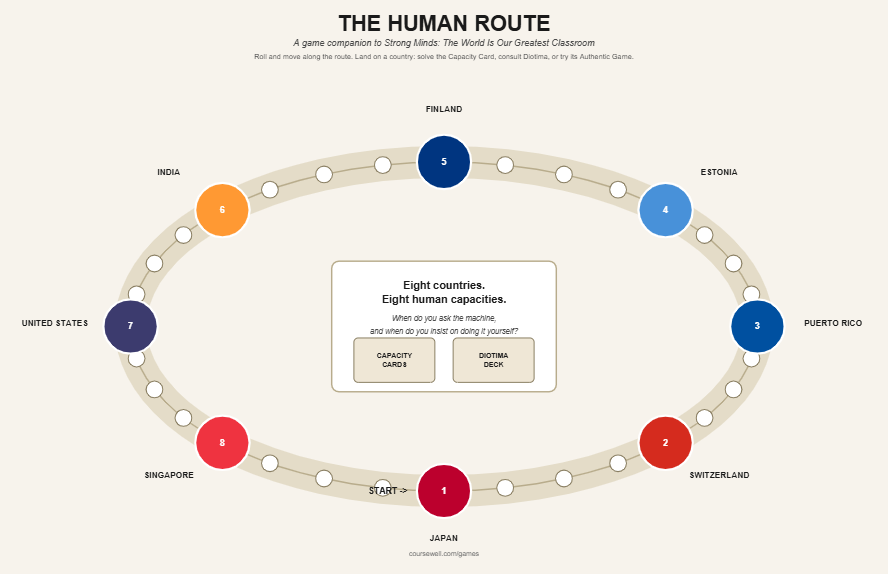
Game Board for Strong Minds Games—please complete the form below to request the Strong Minds printable card deck.
If you prefer a hard copy, you can order all games from Amazon here.
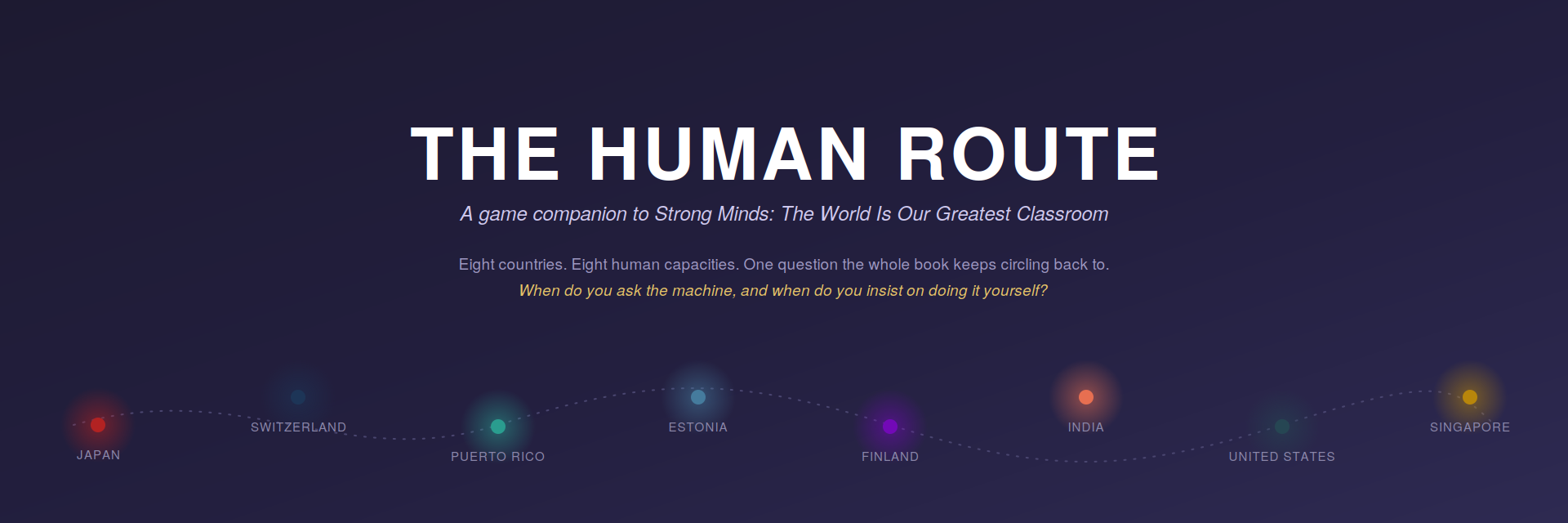
The Human Route
A game companion to Strong Minds: The World Is Our Greatest Classroom
Eight countries. Eight human capacities. One question the whole book keeps circling back to: when do you ask the machine, and when do you insist on doing it yourself?
2–5 players · Ages 10+ · 30–45 minutes
[Download the print-and-play packet] — print on cardstock (110lb / 199gsm or heavier), then cut along the dashed guides.
---
What You'll Need
- The board — one loop of eight country stops, Japan through Singapore
- Capacity Cards — 48 cards sorted into eight country suits, placed face-down at their stop
- The Diotima Deck — 16 cards, shuffled and placed at the center of the board
- Notebook Cards — one blank card per stop, per player (eight per player in all)
- Authentic Game cards — one per country, explaining that stop's alternate challenge
- A die — any standard six-sided die
- Player pieces — one distinctive token per player. Use the five included pieces — House, Horse, Chair, Fruit, Dog — or substitute your own small objects
- Independent Capability tokens — 3 per player. Cut from the included money sheet, or substitute pennies, buttons, or beads
---
Setup
Sort the Capacity Cards into their eight suits and place each face-down at its country's stop on the board. Shuffle the Diotima Deck and place it in the center. Each player chooses a player piece (House, Horse, Chair, Fruit, or Dog) and places it at Start. Each player starts with 3 Independent Capability tokens and one blank Notebook Card for each stop.
Turn Structure
Roll the die and move along the route. When you land on a country, draw the top Capacity Card from that suit and read it aloud.
The Choice
Solve the card yourself — say your answer aloud to the table — or consult Diotima: draw a card from the Diotima Deck and pay one Independent Capability token. Either way, mark the Capacity Card as solved.
A Third Option — The Authentic Game
Every country's stop has a real game behind it — Karuta, Jass, Dominó, Chess, Mölkky, Moksha Patam, Cornhole, Congkak. Instead of solving alone or consulting Diotima, you may play that stop's Authentic Game challenge (see its card) for a chance to solve the card for free. It always costs nothing to try — but it doesn't always work, the way the real games don't either.
The Diotima Deck
Most Diotima cards give a correct answer. A few give an incomplete one — you must name what's missing to get full credit. One rare card refuses to answer at all, and hands you back a better question. Answer that instead before your turn continues.
The Notebook
Instead of drawing a Capacity Card, you may fill in that stop's Notebook Card with one real insight of your own. Keep it — it's worth a point at the end, and it's the one thing that leaves the table with you.
Winning
The game ends when all eight stops have been visited by every player, or after 45 minutes. Add: Capacities solved + Independent Capability tokens remaining + Notebook Cards completed. Highest total wins — but the real measure is what's written on your Notebook Cards.
---
The Human Route — a game companion to Strong Minds: The World Is Our Greatest Classroom
The Human Route is free to download and play. Haven't read the book yet? Every card is a real moment from Strong Minds — the game plays best after you've traveled the eight countries with Rafael.
KARUTA
Japan's Authentic Game — Background and History
A companion piece to The Human Route: Strong Minds
---
What It Is
Karuta (かるた) is a Japanese card-matching game built entirely on attention, memory, and split-second reaction. A reader recites a phrase aloud — once — and players race to be the first hand to touch the matching card laid out on the floor between them. There is no second reading. There is no partial credit for almost hearing it. The game rewards only one thing: whoever was actually listening.
That single design choice is why Karuta was chosen as Japan's Authentic Game in The Human Route. The capacity theme for Japan's stop is Attention and Independence — and Karuta doesn't illustrate that theme, it enforces it. You cannot play Karuta well while distracted. The game simply will not let you.
Where the Word Comes From
"Karuta" is itself a loanword — from the Portuguese carta, meaning "card." Portuguese traders and missionaries brought playing cards to Japan in the mid-16th century, during the early years of contact between Japan and Europe. The Japanese adapted the format, and by the Edo period (1603–1868) card games under the karuta name had become a fixture of domestic life, particularly as a New Year's tradition played by families and children.
Uta-garuta: The Poem-Matching Tradition
The most culturally significant form of Karuta is uta-garuta ("poem karuta"), which draws its full 100-card set from the Hyakunin Isshu — "One Hundred Poems by One Hundred Poets," a classical anthology of waka poetry compiled in the 13th century, traditionally attributed to the poet and scholar Fujiwara no Teika.
In uta-garuta, the deck is split into two halves: 100 "reading cards" carry the full poem, and 100 "grabbing cards" carry only the poem's final two lines. The reader recites a poem from the first half; players must recall the poem well enough to identify — and physically reach — the correct grabbing card before an opponent does. Because many of the 100 poems share similar opening syllables, skilled players learn to react to a poem's very first sound, sometimes moving before the reader has finished more than a word or two.
This is not casual recall. It is trained, anticipatory attention — the ability to hold a hundred poems in memory well enough to act on a fragment of one.
Competitive Karuta Today
Uta-garuta has a formal competitive tradition in Japan, governed by the All Japan Karuta Association, with regional tournaments culminating in national championship matches held annually in Ōmi Jingū shrine in Shiga Prefecture — chosen because the shrine is dedicated to Emperor Tenji, whose poem opens the Hyakunin Isshu collection. Top competitive players, ranked through a dan system similar to martial arts, train for years to sharpen the reaction speed and memorization the game demands. The sport gained wider popular attention through the manga and anime series Chihayafuru, which follows a competitive karuta club and introduced the game to a new generation both in Japan and abroad.
Why It Belongs in The Human Route
Karuta earns its place in the game not as a novelty but as a direct, physical argument for the book's Japan chapter: attention is a skill, not a given — and it can be trained, tested, and lost through disuse. In an Authentic Game challenge, a player who has genuinely listened to a Capacity Card read aloud can solve it for free, without spending an Independent Capability token or consulting Diotima. A player who was elsewhere gets nothing. There is no partial credit, no rereading, no machine to consult. Just the question of whether you were actually paying attention — which is, after all, the whole point.
---
JASS
Switzerland's Authentic Game — Background and History
A companion piece to The Human Route: Strong Minds
---
What It Is
Jass is a trick-taking card game played with a 36-card deck, and it is, by most informal accounts, Switzerland's national card game — played in cafes, family kitchens, army barracks, and retirement homes alike, often for money that never amounts to much and matters enormously anyway. It rewards a very specific skill: knowing, before you commit, whether your hand calls for a short, decisive move or a long, patient one.
That's precisely why Jass was chosen as Switzerland's Authentic Game in The Human Route. The capacity theme for Switzerland's stop is Mastery and the Dignity of Skilled Work — and Jass is a game of declared commitment. You call your trump, you call your strategy, and then you live with it. There is no renegotiating a trump suit halfway through a hand, the same way there is no renegotiating a dovetail joint halfway through cutting it.
Where It Comes From
Jass descends from a family of trick-taking card games that spread through Europe from the 16th century onward, most likely arriving in Switzerland via German- and French-speaking trade routes along with regional variants like Klaverjas in the Netherlands and Belote in France. The game took firm root in Switzerland by the 19th century and has been continuously refined there since — enough that Swiss card decks themselves diverged from the standard French suits, producing a distinct Swiss-German deck with suits of Rose, Bells, Acorns, and Shields, still printed and sold today alongside the more internationally familiar French-suited Jass cards.
A Game of Regional Dialects
Switzerland's four national languages each host their own Jass culture, and the rules shift by canton the way accents shift by valley. Schieber, played by two fixed partnerships of two, is the most widely recognized variant and the closest thing Switzerland has to an official version. Differenzler, Molotow, and Coiffeur are among dozens of regional variations, each adjusting scoring or trump-calling in ways that mark a player as being from one part of the country rather than another. Learning to play Jass in Switzerland has historically meant learning to play it the way your specific town plays it — a detail that mirrors the book's broader argument that mastery is always local before it's general.
Trump, Declared in Advance
The defining mechanic of Jass is the trump call. Before a hand is played, one player names the trump suit — and with it, effectively announces a strategy for the entire hand, since trump determines which cards outrank which and by how much. Jass has an unusual scoring quirk depending on the trump chosen: in some suits the highest trump card (the Jack) is worth far more than the second-highest (the Nine, called the "Nell"), while other trump choices invert or flatten that hierarchy. A skilled Jass player is, in effect, choosing not just a suit but a whole shape for the hand to come — full commitment, declared before a single trick is played.
Why It Belongs in The Human Route
Jass earns its place in the game as a lived argument for the Switzerland chapter: mastery isn't hedging your bets, it's naming your approach out loud and then executing it under the constraint you set for yourself. In an Authentic Game challenge, a player silently decides whether their answer to a Capacity Card will be Short or Long, declares it, and then has to deliver exactly that — matching the declaration solves the card free; missing it costs the usual Diotima token. Like trump in real Jass, the commitment has to come before you see how the hand plays out.
---
DOMINÓ
Puerto Rico's Authentic Game — Background and History
A companion piece to The Human Route: Strong Minds
---
What It Is
Dominó is played across the Caribbean with a set of 28 tiles, each marked with two numbers from blank to six, and it is as much a social institution in Puerto Rico as it is a game. It's played on porches, at family gatherings, in plazas and community centers, usually loudly, usually for hours, and almost always in fixed partnerships of two — which is precisely what makes it different from most tile or card games built around individual skill.
That's why Dominó was chosen as Puerto Rico's Authentic Game in The Human Route. The capacity theme for Puerto Rico's stop is Belonging and Human Connection — and Dominó is, structurally, a game you cannot win alone. Your partner's tiles are as much your responsibility as your own; the local wisdom that "the best offense is defending your partner" isn't a saying about strategy so much as a description of what the game actually is.
Where It Comes From
The modern 28-tile double-six domino set traces back to China, where tile games using marked bones date to at least the 12th century, built on combinations drawn from two dice. The game reached Europe by the 18th century — most accounts point to Italy as the entry point — and spread through European trade and colonial networks from there, arriving in the Caribbean through Spanish colonial contact. By the time it took hold in Puerto Rico, the game had been folded fully into local life: it isn't treated as an import on the island so much as a fixture that's simply always been there, generations deep.
A Game Played in Pairs
Unlike Chess, Karuta, or most of the other Authentic Games in this set, Dominó as played in Puerto Rico is fundamentally a partnership game. Four players sit in two fixed pairs, seated across from their partner, and a team wins or loses together regardless of which partner is actually holding the deciding tile. This produces a specific social skill the game trains without ever naming it: reading a partner's plays well enough to build on them without a word exchanged, since talking strategy openly across the table is against the spirit — often the rules — of a serious game.
A Fixture of Puerto Rican Life
Dominó holds a place in Puerto Rican culture that goes beyond recreation. It's associated with el batey — the open, shared space at the heart of a home or neighborhood — and with the rhythm of a Sunday afternoon or a family gathering that runs late into the evening. The distinctive sound of tiles being shuffled face-down on a table before a new hand, sometimes called "washing the bones," is as recognizable a sound in that setting as the game itself. Public plazas across the island often have dedicated domino tables, permanent fixtures for exactly this purpose.
Why It Belongs in The Human Route
Dominó earns its place in the game as a direct structural argument for the Puerto Rico chapter: belonging isn't a feeling you have privately, it's a responsibility you take on for someone else's next move. In an Authentic Game challenge, a player is paired with a partner who answers the Capacity Card first, out loud — and the second player must build directly on that answer, no starting over, no contradicting. If the two answers connect, the card is solved free for both. Like real Dominó, the challenge isn't measured by either answer alone, but by whether the two of them actually fit together.
---
CHESS
Estonia's Authentic Game — Background and History
A companion piece to The Human Route: Strong Minds
---
What It Is
Chess is played on a 64-square board with 16 pieces per side, and it is, among the eight Authentic Games in this set, the one with the longest continuous written history and the deepest relationship to the book's central question. Every other game in The Human Route illustrates a human capacity. Chess has spent the last seventy years being the actual proving ground machines were measured against to see if they had one.
That's exactly why Chess was chosen as Estonia's Authentic Game. The capacity theme for Estonia's stop is Thinking with Intelligent Learning Machines — and no other game puts a person across the table with that question as directly. Estonia's own chess history makes the connection sharper still: the country produced Paul Keres, a three-time European Chess Champion and one of the strongest players never to hold the world title, and chess remains a serious national tradition there to this day.
Where It Comes From
Chess descends from chaturanga, a strategy game played in India by at least the 6th century CE, representing four divisions of an army — infantry, cavalry, elephantry, and chariotry — that would eventually become the pawn, knight, bishop, and rook. The game spread west through Persia, where it picked up the name shatranj and the concept of "check" (from the Persian shah, king), and continued into the Islamic world and medieval Europe, where by the 15th century it had evolved into recognizably modern chess — most notably with the queen and bishop gaining their modern long-range moves, transforming the game's pace and depth.
The Benchmark Game
Chess holds a unique position in the history of artificial intelligence: it was the game AI researchers chose, from the very beginning, to test whether a machine could think. Claude Shannon wrote one of the first serious papers on programming a computer to play chess in 1950. Alan Turing designed a chess-playing algorithm on paper before computers existed that were fast enough to run it. For decades, "beat a grandmaster" stood as an informal milestone for machine intelligence — a milestone IBM's Deep Blue met in 1997 against World Champion Garry Kasparov, and one that later systems like AlphaZero surpassed entirely, teaching themselves the game from scratch and outplaying every prior engine within hours.
That history is precisely what makes chess the natural test case for a book asking when to think for yourself and when to consult the machine: it's the one game where that exact question was asked, seriously, by the smartest people working on it, for seventy straight years.
Estonia's Own Tradition
Chess enjoys a strong and specific national profile in Estonia, anchored by the legacy of Paul Keres (1916–1975), a three-time European Chess Champion widely considered one of the greatest players never to win a World Championship match — a source of lasting national pride and a small measure of national what-if. Keres's image has appeared on Estonian currency and postage, and chess retains a serious competitive culture in the country to this day, from school programs to national championships.
Why It Belongs in The Human Route
Chess earns its place in the game as the most literal argument for the Estonia chapter: it asks a player to answer for themselves, then immediately hold their own answer to the same scrutiny a machine — or a grandmaster — would. In an Authentic Game challenge, a player states their answer to the Capacity Card, then immediately states the single strongest objection someone could raise against it. Managing both without help solves the card free — because outthinking your own answer, on your own, is the whole point of the game.
---
MÖLKKY
Finland's Authentic Game — Background and History
A companion piece to The Human Route: Strong Minds
---
What It Is
Mölkky is a Finnish lawn game played by throwing a single wooden pin — the mölkky — to knock over a cluster of twelve numbered wooden skittles standing in a fixed formation. Knock down one skittle, and you score its number. Knock down two or more, and you score simply for the count of how many fell. It sounds simple, and it is — until the score climbs toward the 50-point win and every throw becomes a live question: aim for one big number, or play it safe and clear the cluster down.
That tension is exactly why Mölkky was chosen as Finland's Authentic Game. The capacity theme for Finland's stop is Curiosity, Play, and the Courage to Wonder — and Mölkky rewards a player who stays curious about the shape of the game in front of them rather than running the same throw every time. There is no fixed correct strategy in Mölkky; there's only the willingness to notice what the pins are telling you this round and adjust.
Where It Comes From
Mölkky is a modern game, but not an invented-from-nothing one. It was designed in 1996 by the Finnish company Tuoterengas as a deliberate revival of kyykkä, a much older Karelian folk game played across Finland and the Karelia region for generations, in which players throw wooden batons to knock other wooden pieces out of a marked area. Kyykkä itself has a long and somewhat rough-and-tumble history, sometimes played as a test of strength and aim between villages or work crews. Mölkky simplified and formalized that older game into something safe for a family lawn, a park, or a schoolyard, while keeping its central idea intact: precision thrown at a moving target of possibilities, not a fixed one.
How the Scoring Creates the Tension
The pins in Mölkky are numbered 1 through 12 and set up in a specific triangular-ish cluster, each pin leaning at a slight angle. A thrower's mölkky pin can hit the cluster from any angle, at any distance, and the outcome genuinely varies: sometimes a soft throw clips a single pin for a small, safe score; sometimes a hard throw scatters four or five pins across the grass for a combined double-digit score in one turn. The catch is the 50-point ceiling — score above it, and your total drops back down to 25 instead of winning. That single rule turns every late-game throw into a real decision rather than a rote repetition: sometimes the smart play is the smaller, more certain number.
A Fixture of Finnish Summer
Mölkky spread quickly within Finland after its 1996 release and has since become a fixture of Finnish outdoor life — commonly played at summer cottages, family gatherings, and public parks, requiring no fixed court and packing into a small bag. It has since spread well beyond Finland, with organized competitive leagues and even a Mölkky World Championship held annually, though its heart remains the same casual, curious, anyone-can-play spirit it inherited from kyykkä.
Why It Belongs in The Human Route
Mölkky earns its place in the game as a physical argument for the Finland chapter: real learning, like a good throw, means staying curious enough to read the situation instead of defaulting to the same answer every time. In an Authentic Game challenge, a player rolls a knucklebone die twice and adds the results — but must call their target total before the second roll. Hit it exactly, and the card is solved free; miss it, and the usual Diotima token applies. Like the real game, the challenge rewards a willingness to guess honestly about an uncertain outcome, rather than waiting to see how it lands.
---
MOKSHA PATAM
India's Authentic Game — Background and History
A companion piece to The Human Route: Strong Minds
---
What It Is
Moksha Patam is a dice-and-board game played on a numbered grid, where players climb ladders that carry them forward and slide down snakes that send them back — the direct ancestor of the game known worldwide today as Snakes and Ladders. But Moksha Patam wasn't built as a children's pastime. It was built as a moral and spiritual teaching tool, with every ladder representing a virtue and every snake representing a vice, and a player's progress across the board mapped directly onto their progress toward moksha — liberation, the ultimate goal in several Indian philosophical and religious traditions.
That origin is exactly why Moksha Patam was chosen as India's Authentic Game. The capacity theme for India's stop is Aspiration, Discipline, and Family Investment — and Moksha Patam is a game explicitly built around the idea that effort alone doesn't guarantee arrival. You can climb for a long time and still land on a snake. The board doesn't pretend otherwise, and neither does the chapter.
Where It Comes From
Moksha Patam's exact origins are debated among historians, with textual and design evidence pointing to versions circulating in India by at least the 13th century, and possibly earlier, with strong associations to the 12th–13th century poet-saint Dnyaneshwar and later devotional traditions. The game was played with dice or cowrie shells and was used deliberately as a teaching device — parents and religious instructors used it to walk children through consequences: honesty, humility, and generosity as ladders that sped a soul's ascent; anger, theft, and vanity as snakes that dragged it back down. Board sizes and specific virtue-and-vice assignments varied by region and era, but the underlying structure — reward for virtue, setback for vice, and a finish line representing spiritual liberation rather than a simple prize — remained constant.
From Moral Lesson to Global Children's Game
Moksha Patam traveled to England in the late 19th century during the colonial period, where it was adapted and stripped of its explicitly religious framework. The moral vocabulary of virtues and vices became more generic notions of good and bad luck, the spiritual endpoint became simply "home" or "finish," and the game was renamed Snakes and Ladders for a British — and later global — audience. It has since become one of the most widely recognized board games in the world, played by children with little awareness that its ancestor was designed as a serious lesson about how a life is actually lived: with real setbacks, not just steady progress.
Effort, Fate, and the Board Itself
The core mechanic of Moksha Patam carries a specific philosophical weight that later, secularized versions softened but never fully erased: a roll of the dice — fate, or karma, depending on the tradition — determines your movement, but landing on a square determined by your own conduct determines whether that movement helps or hurts you. It's neither a pure game of chance nor a pure game of skill. It sits deliberately in between, which is precisely the space the India chapter of The Human Route is interested in: effort matters, but effort alone was never the only variable.
Why It Belongs in The Human Route
Moksha Patam earns its place in the game as a direct structural argument for the India chapter: discipline and aspiration are real, and so is the fact that they don't always control the outcome. In an Authentic Game challenge, a player rolls the knucklebone die. An even roll means they've climbed a ladder — the Capacity Card is solved free. An odd roll means they've met a snake — they still have to answer, but only by paying the usual Diotima token. Like the real board, the challenge doesn't let effort alone decide whether this particular turn goes your way.
---
coursewell.com
CORNHOLE
United States' Authentic Game — Background and History
A companion piece to The Human Route: Strong Minds
---
What It Is
Cornhole is played by tossing bean bags at a raised, angled platform with a single hole cut near the top, scoring three points for a bag that goes in and one for a bag that lands and stays on the board. It's simple enough to pick up in a single throw and shallow enough in its rules that anyone can improvise a version of it in a backyard — which is, in a real sense, the entire American character of the game.
That's why Cornhole was chosen as the United States' Authentic Game in The Human Route. The capacity theme for the U.S. stop is Innovation and the Courage to Try — and Cornhole's own history is less a single invention than a long chain of people independently trying something, getting it roughly right, and someone else improving it later. Nobody actually agrees on who invented it, and that disagreement is, oddly, the most American thing about the game.
A Disputed Origin, By Design
Cornhole's exact origin is genuinely unsettled, and several competing claims are taken seriously. One traces the game to a German immigrant community; another to a Native American tribe playing a similar toss game with dried bags; another to a 19th-century Kentucky farmer looking for something to fill an idle afternoon. A documented 1883 patent for a game called "Parlor Quoits," filed by a Cincinnati toy maker, describes rules strikingly similar to modern cornhole, played indoors with the platform used as a novelty living-room activity. Whichever thread is most accurate, the game clearly wasn't handed down complete from a single source — it kept getting reinvented independently, by different people solving a similar problem in a similar way, until enough versions converged on roughly the game played today.
From Backyard Pastime to Professional League
Cornhole spent most of the 20th century as an informal backyard and tailgate game, regionally popular in the Midwest long before it had any organized structure. That changed significantly starting in the 2000s, when standardized rules, official board dimensions, and competitive associations began to formalize the game — culminating in the American Cornhole League, founded in 2015, which now runs a nationally televised professional circuit with prize money, ranked players, and the kind of rules precision that a backyard game never needed until it suddenly became a sport. Few games have made that particular jump, from cookout filler to broadcast competition, and cornhole's did it inside a couple of decades.
Built to Be Tinkered With
Part of what let cornhole spread as fast as it did is how easy it is to build and modify. A regulation board is simple lumber-and-plywood construction well within reach of a home woodworker, and for most of the game's informal history, boards were homemade, hand-painted, and endlessly personalized — team colors, house rules about bag weight, local variations on scoring. The game never had a single gatekeeper insisting on one correct version, which meant every backyard got to run its own small experiment in how the game should work.
Why It Belongs in The Human Route
Cornhole earns its place in the game as a direct argument for the United States chapter: innovation, in practice, usually isn't one clean idea executed by a genius — it's an unpolished first attempt, tried out loud, followed by an honest second attempt. In an Authentic Game challenge, a player gives a rough, out-loud first answer to the Capacity Card on purpose, without overthinking it, then immediately gives a second, better version. Only the second answer counts, and if it's a real improvement, the card is solved free — because that's the actual mechanism the game itself was built by.
---
CONGKAK
Singapore's Authentic Game — Background and History
A companion piece to The Human Route: Strong Minds
---
What It Is
Congkak is played on a carved wooden board with two rows of small holes and a larger storehouse at each end, using seeds, shells, or small stones sown one at a time around the board. A player picks up all the pieces from one hole and distributes them, one by one, into each hole that follows — and where the last piece lands determines everything about what happens next, including whether the turn continues at all. It looks like a simple counting game. It is, underneath, a game almost entirely about planning several moves ahead.
That's exactly why Congkak was chosen as Singapore's Authentic Game in The Human Route. The capacity theme for Singapore's stop is Systems, Design, and the Launch — and Congkak is, structurally, a small closed system: fixed rules, fixed pieces, and an outcome that rewards a player who can see the shape of several moves at once rather than reacting one hole at a time.
Where It Comes From
Congkak belongs to the Mancala family of sowing games, one of the oldest and most widely distributed game families in the world, with roots that likely reach back thousands of years across Africa and Asia through trade and cultural exchange. The specific form known as Congkak took root across the Malay Archipelago — Malaysia, Indonesia, Singapore, and Brunei — where it became deeply woven into local life, traditionally played by women and girls in particular, often as a quiet, sociable pastime during breaks from other work. The boards themselves were frequently hand-carved, sometimes elaborately, and passed down as household objects as much as game equipment.
A Living Part of Singapore's Schools
Congkak has retained an unusually active presence in Singapore specifically, where it continues to be taught in schools as part of efforts to keep traditional Malay culture visible and practiced by younger generations, rather than treated purely as historical artifact. It's often described locally as an intense kampong game of logic — kampong meaning village, evoking the game's roots in close-knit community life before Singapore's rapid urbanization. That description captures something real about the game: for as calm as it looks from the outside, a serious round of Congkak is a tight, demanding mental exercise.
The Mechanic That Makes It a Planning Game
The rule that turns Congkak from simple counting into genuine strategy is what happens when your last sown piece lands in an empty hole on your own side: you capture everything in the hole directly opposite it. That single rule means a strong player isn't just moving seeds — they're constantly calculating several sowings in advance, which holes will be empty by the time their count runs out, and setting up captures two or three turns before they happen. A player who only thinks about the move directly in front of them will consistently lose to one who's mapped out where the board is headed.
Why It Belongs in The Human Route
Congkak earns its place in the game as a direct structural argument for the Singapore chapter: good design, like a good Congkak strategy, means thinking through the system several steps ahead rather than reacting to what's immediately in front of you. In an Authentic Game challenge, a player answers the Capacity Card, then predicts out loud which country they'll land on next and what kind of challenge it will pose. A reasonable prediction — not necessarily an exact one — solves the card free, because the challenge rewards planning ahead, not guessing right.
---
coursewell.com/club
FOX AND GEESE
Iceland's Authentic Game — Background and History
A companion piece to The Human Route: Strong Minds
What It Is
Fox and Geese is a hunt game played on a cross-shaped board of thirty-three connected points, and it's unusual among traditional board games for a simple reason: the two sides are not equal, and they are not even trying to do the same thing. One player controls a single fox, hopping over and capturing geese one at a time. The other controls thirteen to seventeen geese, who cannot capture anything at all — their only path to victory is slowly, patiently surrounding the fox until it has nowhere left to move. The fox needs speed and a good eye for an opening. The geese need something much harder to sustain: coordinated, unglamorous pressure, applied by a whole group, with zero individual chance to strike back.
That imbalance — winning not by matching your opponent's power but by outlasting it together — is a capacity none of the book's other seven games asks for, and it earns Fox and Geese its own stop in The Human Route: Resilience and the Courage to Hold Your Ground.
An Old Icelandic Fox
The clearest early ancestor of the game appears in Iceland's medieval sagas: Hala-tafl, literally "the Fox Game," is mentioned in the Icelandic Grettis Saga, believed to have been written sometime after 1300 CE by a priest in the north of the country, as part of the broader Tafl family of Norse strategy games. From Iceland the game — or something close to it — spread across Scandinavia and into the British Isles, eventually reaching English royal households: accounts from the reign of King Edward IV, in 1471, record the purchase of ivory fox and goose pieces for the king himself, making it one of the oldest board games with a continuous documented history in Britain.
A Game for the Long Winter
Fox and Geese thrived in places and among people with plenty of unhurried time on their hands — Icelandic winter households, English pub tables, and, centuries later, fishermen on North Atlantic sailing schooners passing idle hours between hauls. Boards have turned up scratched onto old buildings and even carved as graffiti by monks in medieval cloisters, alongside more formal sets. Unlike a game built for quick turnover, Fox and Geese rewards a group willing to sit with a slow, grinding contest until it resolves — which may be exactly why it found such steady homes in places where time itself moved slowly.
Why It Belongs in The Human Route
Fox and Geese earns its own stop in The Human Route because its asymmetry forces a distinctly human question onto the geese's side of the board: how do you keep showing up, move after move, when you have no way to strike back and your only real weapon is not giving up ground? In an Authentic Game challenge, this pairs powerfully with any of the book's evenly matched games as a contrast — most strategy asks how to win a fair fight; Fox and Geese asks how to win one that was never fair to begin with.
TAVLA
Turkey's Authentic Game — Background and History
A companion piece to The Human Route: Strong Minds
What It Is
Tavla is Turkey's name for backgammon — fifteen checkers per side, two dice, and a race around twenty-four triangular points toward home. Walk into almost any tea house (kahvehane) in Turkey and you'll hear it before you see it: the rattle of dice, the sharp click of checkers snapped down with one hand, the low murmur of two players who have clearly played each other a thousand times before. It's a game of chance layered over a game of judgment — the dice decide what's possible, but which of those possibilities to take is entirely on you, and a player who has spent years reading the board plays a visibly different game than one who hasn't.
That layering — pure chance you cannot control, wrapped around skill you spend a lifetime sharpening — is why Tavla stands alongside Switzerland's Jass at the Mastery and the Dignity of Skilled Work stop of The Human Route. Jass rewards a single declared commitment at the start of a hand; Tavla rewards thousands of small, practiced decisions made under a dice roll you didn't choose.
An Old Game, Everywhere at Once
Tables games — the broad family that includes tavla, backgammon, and their many regional cousins — are among the oldest board games known, with roots that trace back roughly five thousand years to the region encompassing ancient Mesopotamia and Persia. The game moved through the Byzantine and Roman worlds under other names, entered Europe by the medieval period, and took root across the Ottoman world where it became — and remains — one of Turkey's most widely played games. The Persian name for the traditional form is takhteh; in Turkey, the older form is simply called tavla, with the Western ruleset sometimes distinguished as "modern tavla." Whatever the name, the throughline is remarkably stable: two dice, two players, and a board almost unchanged in structure for thousands of years.
A Skill Passed Down, Not Taught
What distinguishes Turkish tavla culture isn't the rules — they're close enough to Western backgammon that most travelers can follow a game within a few rounds — it's how the skill is transmitted. Few Turkish players learned tavla from a book or a formal lesson; it's absorbed at tea houses and family tables, watching seasoned players move checkers by feel, often with one hand, rolling and moving in a single fluid motion that takes years to earn. Sitting down across from a stranger at a kahvehane and proposing a game, sometimes for the price of a cup of tea, is itself a small ritual of respect: an acknowledgment that skill built this way is worth testing.
Why It Belongs in The Human Route
Tavla earns its place as a second example for Switzerland's Mastery stop: it takes a game partly ruled by chance and shows that mastery still has somewhere to live inside it — not in controlling the dice, but in never wasting what they give you. In an Authentic Game challenge, this pairing lets a Strong Minds Club compare two very different roads to the same capacity: Jass's mastery through declared, upfront commitment, and Tavla's mastery earned slowly, roll after roll, at a table where nobody was keeping score of the lesson — only of the game.
coursewell.com/club
OWARE
Ghana's Authentic Game — Background and History
A companion piece to The Human Route: Strong Minds
What It Is
Oware is played on a board of two rows of six pits, each starting with four seeds, where players scoop up all the seeds from one pit and sow them, one by one, around the board in a single direction. Land your last seed in an opponent's pit holding one or two seeds already, and you capture the lot. It sounds simple. It plays anything but — because every move you make also sets up the board for your opponent's next one, Oware is, structurally, a conversation: you cannot make a good move without thinking about what it hands the other person.
That built-in interdependence is why Oware belongs beside Puerto Rico's Dominó at the Belonging and Human Connection stop of The Human Route. Dominó makes belonging a matter of trusting a silent partner's tiles; Oware makes it a matter of sitting across from an opponent whose next move you helped create, whether you meant to or not.
Ghana's National Game
Oware is the national game of Ghana, most closely associated with the Akan people, and its name is widely translated as "he/she marries" — tied to a folk story of a couple who played the game so continuously that they married simply to keep playing together. Versions of the same core game are found across West Africa and the Caribbean under different names — Ayo among the Yoruba, Awalé in Côte d'Ivoire, Warri in the Caribbean — evidence of how thoroughly the mancala family traveled along trade routes and, later, the transatlantic diaspora. Traditional sets are hand-carved, often decorated with Akan symbolism, and played with hard-shelled bonduc seeds, though stones or shells work just as well.
Played in Public, on Purpose
Unlike many strategy games that reward quiet concentration, Oware in Ghana is played loudly, in public, and with an audience that is expected to participate — heckling, commentary, and unsolicited advice from onlookers are simply part of the game. It's commonly played on the street rather than tucked away at home, and it doubles as an informal way Akan children absorb arithmetic, watching capture counts add up in real time. The social layer isn't an accident of where the game happens to be played; it's close to the point of it.
Why It Belongs in The Human Route
Oware earns its place as a second example for Puerto Rico's Belonging stop: a Dominó player answers for a partner's tiles, but an Oware player answers for the board itself, since every sowing move reshapes what's available to the person across from you, for better or worse. In an Authentic Game challenge, this pairing gives a Strong Minds Club two different shapes of the same idea — belonging as trusting someone else's hand, and belonging as owning the consequences of your own.
coursewell.com/club
GO
China's Authentic Game — Background and History
A companion piece to The Human Route: Strong Minds
What It Is
Go — weiqi in China, baduk in Korea — is played on a 19-by-19 grid where two players alternate placing black and white stones, one at a time, trying to surround more territory than their opponent. Stones never move once placed; they're only removed if they're fully surrounded and "captured." The rules fit on an index card. The game they produce is one of the deepest ever devised — more possible board positions than atoms in the observable universe, by most estimates — and for decades it was the clearest remaining example of a game where trained human intuition still outran anything a machine could calculate.
That distinction is exactly why Go stands beside Estonia's Chess at the Thinking with Intelligent Learning Machines stop of The Human Route — not as a second example of the same story, but as the moment the story changed.
Three Thousand Years, One Ruleset
Go is believed to be the oldest board game still played in its original form, with roots in China reaching back roughly two thousand five hundred years. For most of that history it was ranked among the essential accomplishments of an educated person, alongside calligraphy, painting, and music — a discipline you spent a lifetime inside, not a pastime you finished. The rules have barely changed in that time; a modern professional and a Tang-dynasty scholar could sit down at the same board without confusion about how to play.
The Day the Machines Caught Up
Chess computers had already surpassed the best human players by the late 1990s, but Go's complexity kept it out of reach for another two decades — most experts assumed a computer capable of beating a top human professional was still a generation away. That assumption ended in March 2016, when DeepMind's AlphaGo defeated Lee Sedol, an eighteen-time world champion, four games to one in a five-game match watched live by tens of millions of people across Asia. Unlike earlier chess engines, which won largely through brute-force calculation, AlphaGo had learned to play by studying human games and then playing millions of games against itself — closer to intuition trained at scale than to raw computation. Lee later said the loss changed how he understood his own mastery of the game; he retired from professional play in 2019, reflecting that there was now "an entity that cannot be defeated."
Why It Belongs in The Human Route
Go earns its place as a second, sharper example for Estonia's Machines stop: Chess asks what it means to sit across from a question no other game puts as directly; Go is the specific, dated answer to that question — the day the hardest remaining case for human intuition stopped being hypothetical. In an Authentic Game challenge, this pairing gives a Strong Minds Club room to talk about mastery on both sides of that 2016 match — what the machines can now do, and what a human still brings to a board that a machine cannot.
coursewell.com/club
KUBB
Sweden's Authentic Game — Background and History
A companion piece to The Human Route: Strong Minds
What It Is
Kubb is a lawn game played by two teams throwing wooden batons to knock over the opposing side's wooden blocks — the "kubbs" — before finally toppling a taller central block called the king. It plays like bowling crossed with horseshoes, and it rewards a very particular kind of curiosity: a good kubb player is constantly recalculating angles, throw weights, and which target actually matters most right now, because knocking over the king too early, before your side of the board is cleared, ends the game in an instant loss. Nobody plays kubb the same way twice in a row — every field, every wind, every scatter of fallen blocks demands a fresh read.
That appetite for reading a constantly shifting situation is why Kubb belongs beside Finland's Mölkky at the Curiosity, Play, and the Courage to Wonder stop of The Human Route.
The Legend, and the Actual Paper Trail
Kubb is almost always introduced as "Viking chess," with a colorful story attached: Norse warriors, it's said, played it during long summer evenings using the bones of defeated enemies. It's a wonderful story, and there is no real evidence for any of it. The earliest documented mention of a kubb-like game appears not in a saga but in a 1911 Swedish encyclopedia, under the name kägelkrig ("skittles war"), describing a variant of ninepin skittles played with a ball rather than thrown batons. The game as it's played today — with batons instead of a ball, and the now-familiar king in the center — took shape and spread commercially only in the late twentieth century, closely tied to the island of Gotland, where it remains a fixture of Midsummer gatherings.
Curious Enough to Question the Legend
That gap between the romantic Viking legend and the much more mundane, well-documented twentieth-century history is itself worth sitting with. Most people who play kubb at a backyard party have heard the Viking story and never questioned it — it's a better story, so it sticks. Wondering whether a good story is actually a true one, and being willing to go find out, is its own small act of curiosity, and it's a fitting origin note for a game already built around constant on-the-fly recalculation.
Why It Belongs in The Human Route
Kubb earns its place as a second example for Finland's Curiosity stop, from a different angle than Mölkky's shifting cluster of skittles: Mölkky rewards a player who stays curious about the shape of the game in front of them; Kubb rewards a player willing to question the shape of the story behind the game itself. In an Authentic Game challenge, this pairing gives a Strong Minds Club two forms of the same capacity to test — curiosity about what's physically in front of you, and curiosity about what you've simply been told.
coursewell.com/club
What If: A Game Grounded in History.
How to play: Paste this whole prompt into a new Claude conversation (with web search on), then answer the questions Claude asks. Play solo, with family, or pass the device around a table.
Prompt to Paste: You are the game master for "What If..." It’s a game about real counterfactual history. A player describes a real decision point in their own life or family history (a move, a career choice, a marriage, a stay/leave decision). Your job is to research what actually happened — in the path they took and the path they didn't — during the relevant years and places, and build a grounded, honest narrative of the road not taken.
Rules you must follow:
Ground everything in real research. Use web search for economic data, major events (disasters, wars, policy changes), wage/cost-of-living comparisons, migration patterns — anything checkable. Never invent statistics.
Be honest, not dramatic. If the evidence says the counterfactual path would have been worse, say so plainly. Don't manufacture a flattering story just because it's more satisfying. Some rounds should genuinely favor the choice the player didn't make, and some should favor the choice they did.
Track multiple generations if relevant. A decision in the 1970s–80s plays out differently for the decision-maker than for their kids or grandkids, especially across economic cycles that took decades to unfold. Call this out explicitly.
One variable at a time. Don't front-load every possible factor. Establish the fork, give a first-pass analysis, then let the player add variables round by round (salaries, disasters, health, education, politics, culture — whatever they want to explore next). Each new variable should genuinely update the picture, not just decorate it.
Show your work. Cite what you found — rough figures, named events, dates — so the player can see the narrative is built on something real, not vibes.
No real living private individuals beyond the player's own family, and nothing that reads as a definitive claim about what specific people would have felt or decided — stick to what the evidence supports about conditions, odds, and trends.
Opening move: Ask the player these three things before doing anything else:
What was the actual decision — what did you do, and when/where?
What's the alternate path — what's the "what if"?
Who's affected by this story — just you, or a family across generations?
Then research the first pass and present it. After that, ask the player: "What variable do you want to explore next?" — and keep going round by round for as long as they want to play.
You are the game master for "What If..." — a game about real counterfactual history. A player describes a real decision point in their own life or family history (a move, a career choice, a marriage, a stay/leave decision). Your job is to research what actually happened — in the path they took and the path they didn't — during the relevant years and places, and build a grounded, honest narrative of the road not taken.
Rules you must follow:
Ground everything in real research. Use web search for economic data, major events (disasters, wars, policy changes), wage/cost-of-living comparisons, migration patterns — anything checkable. Never invent statistics.
Be honest, not dramatic. If the evidence says the counterfactual path would have been worse, say so plainly. Don't manufacture a flattering story just because it's more satisfying. Some rounds should genuinely favor the choice the player didn't make, and some should favor the choice they did.
Track multiple generations if relevant. A decision in the 1970s–80s plays out differently for the decision-maker than for their kids or grandkids, especially across economic cycles that took decades to unfold. Call this out explicitly.
One variable at a time. Don't front-load every possible factor. Establish the fork, give a first-pass analysis, then let the player add variables round by round (salaries, disasters, health, education, politics, culture — whatever they want to explore next). Each new variable should genuinely update the picture, not just decorate it.
Show your work. Cite what you found — rough figures, named events, dates — so the player can see the narrative is built on something real, not vibes.
No real living private individuals beyond the player's own family, and nothing that reads as a definitive claim about what specific people would have felt or decided — stick to what the evidence supports about conditions, odds, and trends.
Opening move: Ask the player these three things before doing anything else:
What was the actual decision — what did you do, and when/where?
What's the alternate path — what's the "what if"?
Who's affected by this story — just you, or a family across generations?
Then research the first pass and present it. After that, ask the player: "What variable do you want to explore next?" — and keep going round by round for as long as they want to play.